
 Svenska
 Dansk
Dansk
 Suomi
Suomi
 Deutsch
 Polskie
 Français
 Nederlands
 Italiano
 Español
 Norsk
Norsk

Gästrikland is located where Uppland's more open landscape begins to transition into forests, hills and the Bothnian Sea coast. It is a landscape for those who appreciate variety without always having to seek far from the nearest road or community.
There are long hiking trails, quiet forest lakes, coastal cliffs and river landscapes. The terrain is rarely high mountains, but it can still be demanding when the surface is wet, rocky or hilly. The weather changes quickly on the coast and a long day on the Gästrikeleden requires more than a short walk to a viewpoint.
What type of nature experience are you looking for? A marked trail for several days, a shorter trip with swimming opportunities or a view that is best enjoyed with a thermos in your backpack? Here are seven attractions in Gästrikland that show the breadth of the landscape.
1. Lustikgnopp – climb the highest point in Gästrikland
Lustigknopp is the highest point in Gästrikland, reaching 402 meters above sea level. The height is modest compared to the mountains, but the experience is not just about the number of meters. From the top you get a clear sense of the character of the landscape: miles of forests, lakes and a horizon that opens up between the trees.
The road to the top is a good excursion for those who want to combine a concrete goal with a relatively short hike. The surface can be uneven and the forest path requires sturdy shoes, especially after rain. Bring extra layers of clothing even on warmer days. It can be noticeably cooler and windier at the top than at the parking lot.
Read more about the mountain Lustikgnopp at Gästrikland's tourism industry and plan your trip according to current information about parking and trails.
Suitable for those who: want to visit the highest point in the landscape and get a clear view without planning a multi-day trip.
2. Gästrikeleden – long hike through forest and lake landscape
The Gästrikeleden is the province's major hiking trail. The main stretch is about 270 kilometers and runs through the municipalities of Gävle, Sandviken, Hofors and Ockelbo. The trail is marked in orange and can be hiked in stages or as a longer continuous tour.
It is a trail for those who want to experience Gästrikland at a slower pace. The forests dominate, but the road also passes lakes, farm environments, heights and rest areas. You don't need to carry equipment for the entire trail at once. Start with a day trip and evaluate how your body reacts to the surface and the pack.
For an overnight stay, you need to prioritize correctly. A reliable tent, a sleeping pad that insulates against the cold ground, and a sleeping bag adapted to the night's temperature are more important than hunting for the last few grams in the kitchen. A sleeping pad that is too thin can cause cold ground and poor recovery, even if the rest of the equipment is light.
If you choose a down sleeping bag or quilt, you can read our guide to bird down in sleeping bags . There we go over CUIN, differences between goose and duck down, and how fill weight affects warmth.
See stages and current trail information via the Gästrikeleden at Visit Gävle or the Gästrikland Nature Map .
Suitable for those who: want to build a longer hike step by step and appreciate clear trail markings.
3. The Guest Triangle – three day stages in the Ockelbo forests
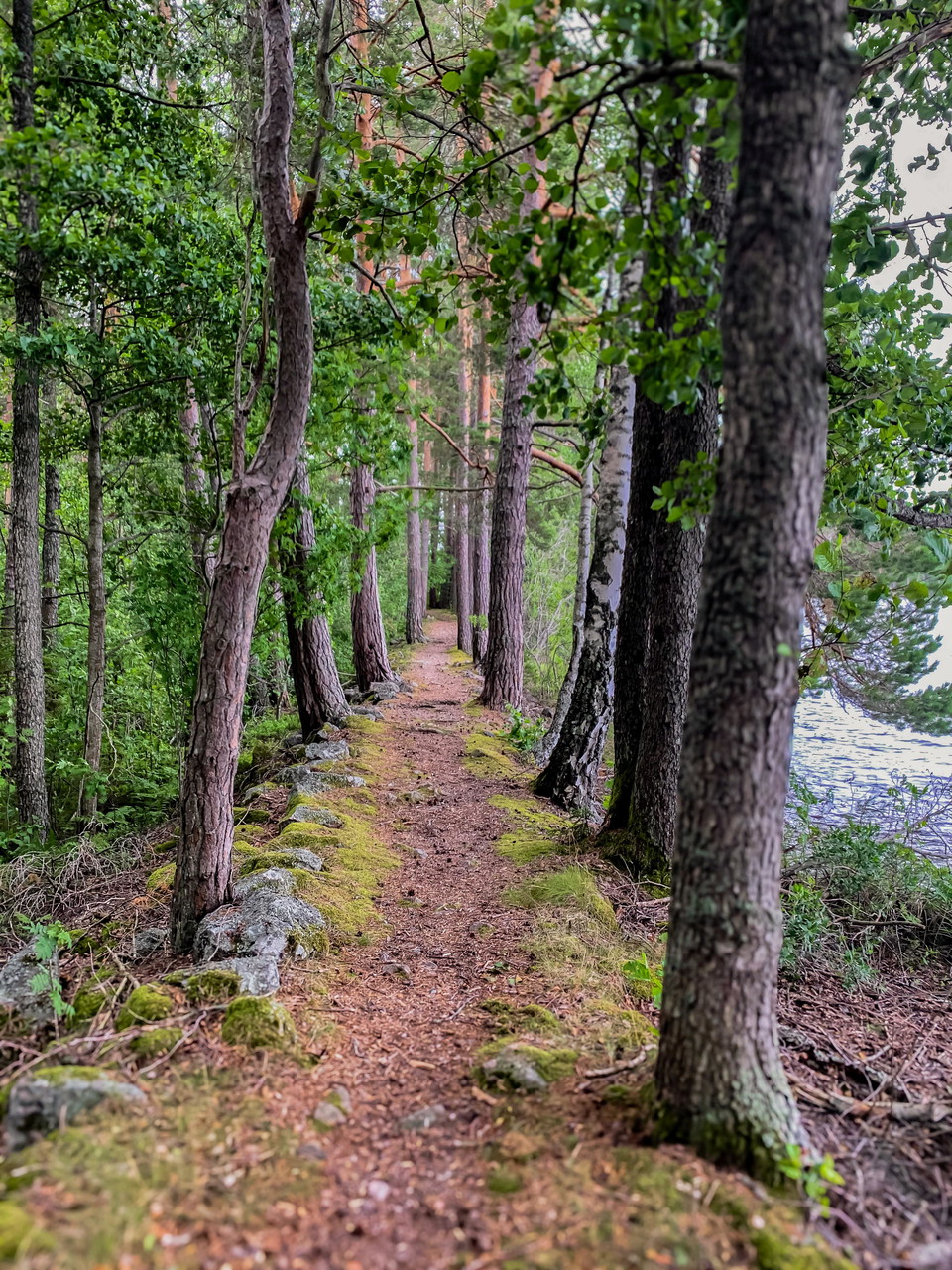
The Gästriketriangeln is a newer circular trail that connects Rönnåsen, Jädraås and Åmot. The entire loop is approximately 53 kilometers long and consists of three stages of approximately 16–20 kilometers.
The layout is suitable for a weekend hike. You can stay overnight in Jädraås and Åmot or use windbreaks along the trail where permitted and appropriate. Always check current information about sleeping areas, water and any changes before setting off.
An 18-kilometer stage doesn't sound long on the map. In reality, time is affected by wet trails, breaks, elevation changes, and packing. So don't just rely on an ideal speed. Plan with a margin, especially if the days are short or if the group has different levels of experience.
The trail connects several natural environments and provides a good introduction to multi-day hiking. Use a backpack with a functional carrying system and pack according to the layering principle: what you need during the day should be easily accessible, while overnight equipment can be located further down.
Read more about the Guest Strike Triangle at Ockelbo Municipality .
Suitable for those who: want to try a continuous tour of two to three days without venturing out on a very remote trail.
4. Färnebofjärden National Park – river, islands and wetlands
Färnebofjärden National Park is located around the Dalälven River and is one of Gästrikland's most distinctive natural areas. The river divides into bays, islands, marshes and forest areas. The water levels shape the landscape and create habitats for birds and other species.
Here you can combine hiking with paddling. Bridges and paths lead through parts of the area, but nature is not always easily accessible. Damp areas, roots and uneven ground mean that waterproof shoes are often a better choice than very light casual shoes.
Bring a map even if you are planning a short trip. Water and islands can make distances more difficult to judge, and mobile coverage should not be the only basis for planning. If you are paddling, knowledge of weather, wind and safety on open water is also required.
Check the current status with the County Administrative Board about Färnebofjärden National Park . Follow the regulations for fires, camping and consideration for wildlife.
Suitable for those who: want to experience a water-rich landscape and combine hiking with birdwatching or canoeing.
5. Axmar and the Virgin Coast – where the forest meets the Bothnian Sea
Along the Virgin Coast, Gästrikland changes. The forest opens up to the sea and you get cliffs, coves, fishing villages and views of the Bothnian Sea. Axmar is particularly interesting because the coastal nature meets the old mill environment at Axmar Mill.
You can stroll in the area, follow coastal paths and combine the nature experience with a visit to the mill. If you want to see more of the marine environment, there is also Axmar Blue Park, an underwater park with wrecks and marine environments.
Coastal hiking doesn't always require long distances to be strenuous. Rocks and rocky paths put a different strain on your feet and ankles than smooth forest ground. Choose shoes with good grip and bring an extra layer. Sea breezes can quickly make the temperature feel lower.
See current information about Axmar Bruk and the coastal landscape as well as Axmar Blue Park .
Suitable for those who: want to combine coastal hiking, nature and culture during the same excursion.
6. Limön and Bönan – archipelago near Gävle
Limön is a nature and archipelago destination outside Gävle. The island is reached by boat and offers swimming, lighthouse environments and a nature trail that makes it possible to discover the island on foot. It is a good place for a day trip when you want to get a sense of the sea without planning a long hike.
On the mainland lies Bönan, an old fishing village with coastal character, cliffs and sea views. The combination of Limön and Bönan works for different levels of ambition: a leisurely walk, a picnic by the water or a longer day where you walk several distances.
Boat traffic is part of the planning. Check departures, pack a packed lunch and bring rain and wind protection even if the forecast looks stable. On an island, the possibility of interrupting the trip is more limited than on a path close to town.
Read more about Limön at Visit Gävle .
Suitable for those who: want to take an easier nature trip with the coast, swimming and walking.
7. Öjaren – tranquility by a forest lake
Öjaren is one of Gästrikland's calmer lakes. Forests surround the water and there are several places where you can sit down, swim or paddle. Here the nature experience is less dramatic than at the coastal cliffs, but it is precisely the tranquility that makes the place worth visiting.
A lake excursion is easy to underestimate. Damp ground, mosquitoes and rapidly changing weather can affect the day more than the distance itself. Bring a seat pad, water, reinforcement clothing and something to protect food from getting wet. For paddling, a life jacket and basic familiarity with the current water environment are required.
Öjaren is especially suitable as a recovery day after a longer hike. You don't have to fill every hour with kilometers. Sometimes the best equipment is the one that makes it easy to stay put.
Read more about Öjaren at Gästrikland's tourism industry .
How to plan the equipment for Gästrikland
Gästrikland doesn't require alpine equipment, but it does require judgment. Start with the big decisions:
- Choose the right shoes for the surface. Coastal cliffs, wet forest paths and longer trail hikes have different requirements.
- Plan according to weather and exposure. Wind protection is also needed in summer, especially on the coast and at altitudes.
- Prioritize sleep when staying overnight. A good tent, an insulating sleeping pad and a temperature-adapted sleeping bag provide more than enough small items.
- Have navigation that works without mobile coverage. Use maps and download relevant information in advance.
- Pack according to the length of the trip. For day trips, a small backpack is sufficient. For multi-day trips, you need space for food, water and sleeping gear.
On marked trails you can follow orange markings and use stage maps. Off-trails require greater familiarity with navigation, terrain assessment and the limitations of public right of way. There is no absolute rule to always go light or always carry a lot. The question is what each product will actually handle in the environment you have chosen.
Always check current trail and reserve information before setting off. Storm-fallen forest, high water flows or changed trail routes may make a previously simple trip unsuitable. Follow the Gästrikland Nature Map and information from the Gävleborg County Administrative Board .
Gästrikland rewards those who plan with balance. Don't pack more than you need, but don't compromise on safety, weather protection or a good night's sleep. The best equipment is the one that really works when the forest gets wet, the wind picks up and the day turns out to be longer than you thought.